Friday, October 18, 2019

Adventures in Gangtok

Sikkim is truly green and clean. It's full of mountains, waterfalls, trees and teeming with bird, insect and plant life.

I have mentioned many many times that my greatest desire would be to wake up and go to work in a place that isn't full of garbage and plastic and that I long for greenery. Maybe I should move to Sikkim.

Gangtok is a nice place- it's crowded and has narrow roads so there are frequently traffic jams (which kind of kills the mood a bit), but the city is quaint, friendly and has a distinctive character to itself. The whole city is carved out of the faces of mountains, so the roads can be quite steep and many times border along precipices. You might be traveling along a crowded section and then you take a turn and all of a sudden, there is nothing in front of you except for clouds, steep drops and cliff sides. I think it would be quite difficult to drink and drive here... not that I would drink and drive anywhere else.

Only tourists drive everywhere though. The locals walk. And climb. A LOT! The walking paths are sometimes by the road, but many times, you will find stairs cut along the mountain face to hasten your way up or down. These stairs can be extremely useful, if they don't lead to dead ends or to someone's house.

View from the hotel window
View from a street corner


Morning sunlight filters down some stairs between houses along the mountain face


A pretty moth in our hotel room
I was happy to see some new species of birds in my early morning walk down the street to the District Court House.
Courtesy: Uajith
https://commons.wikimedia.org/wiki/File:Indian_black-lored_tit.jpg
This is the Indian black-lored tit. I'm always a bit conscious when I use that word. Tit means "little" in Anglo Saxon English and no doubt, when birdwatchers in the 19th and 20th century called this bird so, they meant it with affection and without any fore knowledge on what tits would come to mean by the 21st.

But, no matter their name, these birds are awfully cute. Slightly larger than a sparrow, I first spotted them on the sunshade of a multi-storey building. They are not very shy and in fact call quite loudly. 

The other odd thing I saw in Gangtok was the type of sparrow found there. You find tree sparrows in abundance, not house sparrows. What's the difference, you ask? Tree sparrows have a reddish tinge to their hair on top of their head, making the whole sparrow look just a tad bit redder. House sparrows have a mostly grey-ish hair. In behaviour, noise levels etc., tree sparrows are just about the same as house sparrows.


The Fambonglho Wildlife Sanctuary is about half an hour or so from Gangtok.The WLS is right next to the GB Pant Himalayan Research Center.

Wildflowers like these grow by nearly every house. So beautiful!
A lot of the houses there have their own little gardens and cows.  It was very idyllic.


Durga on her quest to befriend every dog and cat encountered on her way.

Look at Ani reading his bird book while petting the cat!


Where we went
Checking out snails!


Utterly and absolutely impenetrable forest on either side of the road

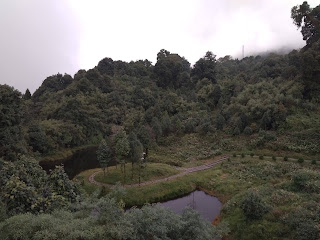
A clearing in the middle of the forest 
Cloud-covered mountains from Fambonglho
Fambonglho was also the first time we saw leeches crawling everywhere- they got on our shoes and were impossible to flick away. Durga had a traumatic experience the first time she saw one get on her shoes and she screamed so loud and long that a few people from a neighboring village came by to see what had happened.

The forests in Fam were incredibly thick- there was no way one could penetrate it- you would be covered in leeches, or in mosquitoes, and perhaps even snakes. There is a narrow, very rocky road leading inside Fam. It's not very well-known, so there are no sounds of civilization, let alone people, on the road. It was a bit frightening, to be honest. The only thing we could hear were various insects, many of which would fall silent as we passed the trees upon which they were, so there was a constant feeling of being watched. I really felt like we were in some version of Fanghorn Forest.

John Claude White, in his book Sikhim and Bhutan: Twenty One Years on the North-East Frontier 1887-1908 had described his efforts to cut through the forests of Sikkim while trying to build roads. He said the forests were stunningly beautiful but the leaves of each plant would be fringed with leeches which would start swaying as soon as they detected any movement. It was apparently very common to get multiple leeches stuck on you and he also said that it wasn't unheard of someone bleeding to death in the forest floor in case they happened to have an injury that prevented their swift passage out of the forest.

We didn't have salt with us and so had to proceed rather cautiously through the WLS. Durga at some point refused to walk and insisted on being carried so she wouldn't get the leeches on herself.

By the time we walked for an hour or so, we could start hearing the birds, but very frustratingly, they remained invisible for the most part. We would catch a glimpse of a bird flying here or there, but they would be completely hidden amongst the thick foliage by the time we focussed the binoculars.

The one bird that I managed to see was the white-tailed nuthatch. Don't get me wrong- it's not like I actually was able to observe this little thing properly while it showed itself off to me. It flew by in a streak and what I did see was the mustard underbelly and the dark blue/black back. And I could estimate the relative size. Based on this, I assume it was the white-tailed nuthatch, because that kind of mustard isn't seen elsewhere in the bird book. So given these disclaimers, I present the white-tailed nuthatch to you:


The White-tailed Nuthatch
http://orientalbirdimages.org/search.php?Bird_ID=2624&Bird_Image_ID=87719&p=33

RK and Ani spotted a striated laughingthrush during the time I was consoling Durga after her leech scare:

Striated laughingthrush
https://www.hbw.com/ibc/photo/striated-laughingthrush-grammatoptila-striata/striated-laughingthrush

During our trek in Fambonglho, we met Mr. Nikhil, a zoologist from the Zoological Survey of India, who was studying moths from the Nolidae family in this region. Why the interest in Nolidae, you may ask. Apparently, they are sort of indicators for the richness and biodiversity of the ecosystem as a whole. The last moth survey done in this region was decades ago in the 1960s (?) and had not included the Nolidae species. So there is an urgent need for finding out some sort of baseline as to just how many and what types of Nolidae exist in this part of the NE Himalayas.

Nikhil was super-cool: he answered dozens of questions, he was so passionate about conservation (he almost cried when describing the reasons why the Indian bustard is almost extinct) and most excitingly, when RK asked him if he could observe his work, agreed instantly. Nikhil's work takes place in the night. He sets up a light in the middle of a pitch dark forest and a white screen. Hundreds of insects fall on the screen in their attempt to get to the light and then he picks the Nolidae moths then, carefully kills (poor moths!) them, and processes them just right so taxidermic classification can be made.
Nikhil goes from forest to forest doing this work and he finds other central govt institutes where he can dump his luggage, get food etc. At night, he says, he doesn't feel scared of most large animals: tigers, leopards etc. leave him alone. But the animal that scares him the most is the bear, because it tends to be very aggressive. In fact, one of his seniors was mauled and almost killed by a bear.

RK and Nikhil at the GB Pant Institute

The intrepid duo on their moth quest
Moth collection at a particular time point

Every couple of hours, Nikhil would check the moth population and pick up any new moths that he hadn't already

Surprisingly beautiful, no?

Just check out the diversity!

While RK spent the night collecting moths, the kids and I enjoyed Gangtok central market. Guess what's amazing about it? No traffic! All motor vehicles are prohibited from entering it. Instead, it resembles some Parisian or Florencian street, with fountains, musicians, bubble blowers etc. My mental habits being what they are, it took me a long time to comfortably walk in the middle of the street and not huddle to the sides.

Gangtok market rocks!
http://shahtour.com/blogs/2017/01/07/15-things-you-must-want-to-buy-while-travelling-in-gangtok/

The next day, we went back to GB Pant, picked up RK and headed to Yuksom, the original and oldest capital of Sikkim and one of the southern most regions of the Kanchenjunga National Park.


Sikkim at last!


At last, 5 days after we left Bangalore, we reached Gangtok.

To get here, we took a shared cab from Siliguri to Darjeeling and another from there to Gangtok. In Darjeeling, we were supposed to take a toy train ride in the steam engine version of the Himalayan Railway (there is also a diesel version). After waiting for more than 2 hours in the railway station and watching Durga make friends with every stray dog in sight, we were told that the train was cancelled. So instead of waiting for another one, we decided to ditch the whole thing and leave for Gangtok.

Darjeeling is entirely covered in fog

Stray dogs in Darjeeling are cute!

The river Teesta, near Kalimpong, about 3 hours from Darjeeling


Gangtok!


Siliguri and Sukhna

"Silly people go to Siliguri", was Durga's favorite statement throughout much of our unexpectedly-gotten train tickets from Kolkata to Siliguri.

This train journey was fabulous- the stuff we got to eat! Rabdi in earthen pots! Authentic mishti doi, not the ultra sweet ones you get from the store! Cups and cups of other Bengali sweets! Kids and hubby slept the journey away in various upper berths, but I sat by the window and sampled all the ware that came through the train- tea, chat, sweets, food. Thank you, God, for my immunity and my stomach :)

You would not believe the amount of flooding in that area.... I mean, we experienced rain-swollen rivers in Odisha and AP, but this, in the heart of the Gangetic plains, was something else.
The whole place was wet, and a few feet underwater. There were miles and miles of land just completely submerged. It explained many things at once: why childhood diarrheal infections are so prevalent in this part of the country, why drowning is a common hazard for young kids, why people tend to be so fatalistic....
I mean, if my house and land and everything surrounding me was submerged for multiple months in a year, I would be pretty depressed and pessimistic and utterly uncaring of most things, I think.

We reached Siliguri 12 hours later. Ugly place, nothing much to recommend the city itself except for its proximity to better places.
But they have electric autos (called Tumtums), which are actually motorcycles with a large sitting space behind. Very nice vehicles- completely quiet, without spewing all the crap that autos usually spew.

About 45min from Siliguri is a place called Sukhna. The Mahananda Wildlife Sanctuary begins here and goes on for many miles north, towards Darjeeling. While the MWS itself was closed because of heavy rains, we got to Sukhna by a Tumtum and spent hours in the most pleasant way.

First, we saw these very odd-looking trees: two trees had lifted up, somehow, and there was a little space between the roots, almost like a tiny hut. Was enchanting.


These trees and their environs were home to creatures like this spider (can you spot it? It's dangling from the top, in the sky):

And this leech:


And this cool-looking nest


Awesome and colorful dragonflies like this one:


Epiphytes like these:


 And much more.

There was a small stream, maybe a distributary of the Mahananda, but very clean. The kids spent hours playing here


For lunch, we walked to the nearby village and ate veg Thukpa, which tasted as amazing as it looks:

And while eating, we saw the Darjeeling toy train!


Apparently it goes from Siliguri to Darjeeling via Sukhna. We would have loved to take that trip, but we had already made bookings on the steam toy train (this was diesel) from Darjeeling to Ghoom. So we satisfied ourselves by waving at the passengers and looking forward to our trip on the little train the next day.

We spotted many birds, including:
The Alexandrine parakeet, which is quite common by cities and towns near the Himalayas (we had spotted them last year in Dharamshala, in the Western Himalayas, around the same time of the year)
https://lafeber.com/pet-birds/species/alexandrine-parrot/

The greater yellow nape woodpecker
Courtesy: Wiki https://en.wikipedia.org/wiki/Greater_yellownape

The gold-fronted leafbird
https://www.youtube.com/watch?v=i4eT6kkHG4o

Southern grey shrike
http://www.tatzpit.com/Site/en/pages/inPage.asp?catID=9&subID=333&subsubID=527

The mynas in this region are not the usual brown and orange, but a black and white version called the Pied myna


The barbets too are not the usual barbets, but like the one below, called the blue throated barbet.
https://en.wikipedia.org/wiki/Blue-throated_barbet
Changeable hawk-eagle, a ginormous bird that swooped overhead 

https://ebird.org/species/chahae1Add caption

River lapwing: we see red lapwings frequently in Chikballapur. This was the first time we were seeing its river- phile cousin

By Francesco Veronesi from Italy - River Lapwing - Corbett NP - India__1321, CC BY-SA 2.0, https://commons.wikimedia.org/w/index.php?curid=39088860

Sukhna was in some ways the prototype of the landscape we would see in parts of Sikkim: gurgling streams, thick, broad-leaved forests, many glades surrounding water-bodies. 

The difference is that Sukhna has wild elephants, which are sometimes quite dangerous.


The surprising beauty of small Indian cities

Who ever thinks of going to vacation in places like Vijayawada or Bhubaneswar? Both these cities, by whatever quirk of fate, are doomed to take second place to their more famous sisters: Visakhapatnam and Puri, respectively.

We ended up in these cities only because they were the most convenient in terms of time and distance for us to break journey on the way to Kolkata (which itself was only on our radar because of its central importance in getting to Sikkim).

Much to our surprise we ended up enjoying and learning quite a lot about both the cities.

Vijayawada- in my mind, Vjw is now inextricably linked with the Krishna. Ani had recently read about the Krishna in his social sciences reader while studying about the Eastern Ghats. We had both gazed at a map to figure out where the river has its source and its mouth... However this was in a geographical map with no mention of cities. Our conversation literally went like, "ok, so it starts somewhere in the middle of this peninsula here, and goes pretty much straight to the right and then starts to dip down and meets the sea about an inch from the nose"
Until I opened up a political map and stared at it for a while, after reaching Vjw, I didn't realise that this city was on the banks of that river.
The Krishna was, quite simply, thrilling to watch. The recent rains had swelled the river to induce the powers that be to release water from the barrage and the resulting flow was thunderous and awe-inspiring.


There are also caves in Vjw. These were started in the 6th or 7th century AD, in use till the 16th century and then abandoned.


Puddles of water collected in small depressions in the rock formed excellent models for teaching the life cycle of mosquitoes.

We thought we would drop by a Durga temple on the way back because it looked nice from a distance. Little did we know that it was one of the most famous temples of that region and, it being the time of Durga Puja, was crammed with people. This temple has adopted the Tirupati model in that there are tickets, endless lines based on how much your ticket costs to view the diety from various angles, tickets for Prasad collection and even tickets for the head shaving business.

Hapless saps that we were, we got into some random line, agreed to some bossy woman who wanted us to buy Rs. 300 tickets, then many many minutes later,realised we were in the wrong line, fought our way back to the beginning of the line, told the security personnel there that we no longer wanted to see any goddess and wanted to leave. Upon which, one of the guards took pity on us, let us in through a side gate and we were among the first to enter the altar and see the goddess. We got a piece of coconut for our troubles and that thrilled Durga no end who then spent many happy minutes shredding coconut chips with her fingernails and teeth. Truly, we are indeed descended from monkeys... Cute ones, but monkeys nonetheless.

Before I move to our adventures in Bhubaneswar, I just make special mention of a place called Sarovar Mess in Vjw- positively the best food I've eaten in a long time. It's very no-frills. It looks like someone converted my Ajji's Chidambaram house in its original avatar into a hotel- it's got that early 1900s look to it, from its wall colours to the grills on the windows to the verandah outside. It also serves food like I think my Ajji might have cooked- amazing! RS. 80 for a full meal per person,

Bhubaneswar- truly mind-boggling that this is the capital city of any place. It's got open drains, a sleepy demeanor and an unmistakable sense that everything in it is because the government has forced it to take it.
However our hotel Vintage Villa had some excellent rooms and great food.

Bhub has a couple of rivers: Daya and Mahanadi. Daya is less-known now, but many centuries ago, by its peaceful and green banks, was the place where Ashoka finally put down his weapons, regretted the bloodshed he had caused and then converted to Buddhism.


Today, that spot is memorialized by a Shanti Stupa, a Buddhist structure built by the Japanese sometime in the 70s in order to re-stimulate Buddhism in India!


 Bhub has a famous temple called Lingaraj, but contrary to its name, doesn't actually have a Shiva in it. It's supposed to be a Hari-Hara temple, in that from the center of the Shivalinga, emerges some sort of a symbol related to Vishnu, but I forget which symbol.

Lingaraj temple has a dozen priests who grab ahold of one as soon as one enters the temple premises and cannot be shaken off. They give you a long tour of the temple filled with many many facts (mostly in comparison to Jagannath Puri... all their statements are like: Puri bhagwan is the younger brother, our Lingaraj is the older brother; the Puri temple was built in the 13th century; out temple was built in the 11th century.... and so on and on and on, endlessly).

Being the saps we are, we were inveigled into purchasing a quarter kg of temple prasadam which we then carted around with us for the rest of our journey. In some ways, it was a good thing: it served as a quick source of munchies when the kids were hungry or when any of us wanted a late night snack.

Most surprisingly, an unplanned visit to the IRCTC website some time during the temple visit showed that there were 3 tatkal tickets available for the next day from Kolkata to Siliguri and in a truly exemplary fashion of rapid clicking, we managed to bag those tickets.

We got in time to Kolk for that train by taking an overnight bus from Bhub to Kolkata, which had unexpectedly broad sleeping berths, and thus, despite only getting 3 berths for the four of us, we felt quite refreshed to tackle the penultimate phase of our journey.

Goodbye Bhub! Goodby Vjw! You are both surprisingly interesting and beautiful. I would have never ever visited you as a holiday destination, so I'm glad I got to visit you by accident.