Tuesday, July 20, 2021

Jayamangali Blackbuck Sanctuary

JBS is in Tumkur District, Karnataka. As per Deepak Sarmah's "Dry Deciduous Forests of Karnataka" Tumkur, most of it is dry, and a mix of scrub and thorn forests, mainly due to continuous and vast anthropogenic pressures on the land (agriculture, overgrazing, logging etc).


See how brown, dry and caked everything around looks?

Regardless, the drive to JBS is beautiful. Don't follow Google Maps after a point, since it will lead you astray. Instead, rely on the locals to tell you where to go. We drove around for almost an whole extra hour before realizing this.  

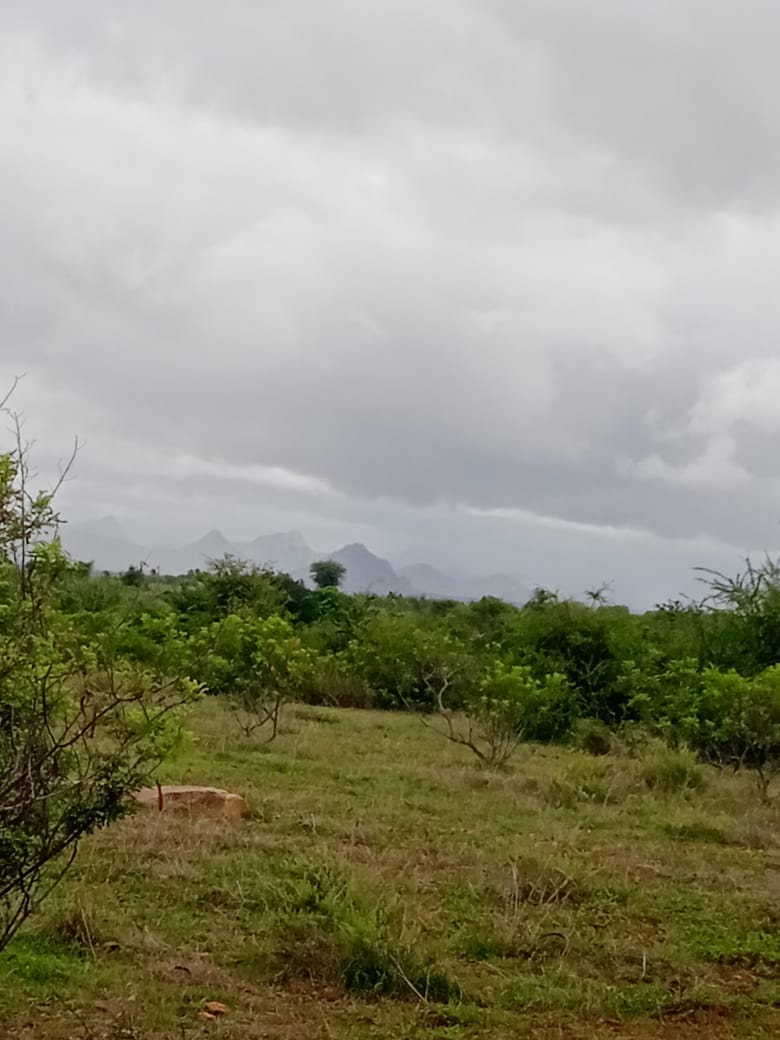
The day was overcast. Clouds broke upon each other like waves on a turbulent sea shore. It kept drizzling on and off. The wind was brisk but not cold. And from JBS we could see over miles and miles of uninterrupted rolling landscapes dotted with shrubs, short trees and grass. Since JBS is literally in the middle of nowhere, it also happens to be one of the ONLY spots in India where one does not hear the sound of any traffic. 

Here are some pics of the landscape:

.                     

.            


Entrance to JBS:

.                 

We reached there only by afternoon (by all online accounts, the best time to get there is 6-8am or 5-7pm). So we were mentally ready not to see any blackbuck, but to enjoy ourselves anyway.

We saw insects: 


This is a yellow pansy butterfly. Pretty, no?  Pic on right from Wiki Commons

We saw blackbuck footprints:


We climbed into and out of ditches


And miraculously, also came across blackbuck!  
Spot the blackbuck (which is not actually black... these are females which are beige)
                                                      

Birds we saw at JBS:
a) Peacocks
b) Egrets
c) Laughing dove
d) Large grey babblers (a noisy bunch... when they all call out, they sound like witches cackling)
e) A shrike which I originally thought was a Great Grey Shrike, but now believe must be a Southern Grey Shrike, after comparing the distribution patterns. The Great Grey is a vagrant in India, whereas the Southern Shrike is widespread through much of peninsular India. Size wise they are about the same (24cm vs 25cm), and they are very similar in coloring and behaviour. 

The Southern Grey Shrike (https://www.flickr.com/photos/42244964@N03/5360119920)

The Large Grey Babbler (Wiki Commons)

What I would like to do at JBS in the future:

There were multiple birds that I could not recognize (including my old nemesis, the Indian Robin). Additionally, this was the first time I took a slightly more scientific view of butterflies (cataloging them, taking pictures, keeping a record of the ones seen).
What I would like to do is to take a survey of the birds and butterflies seen in the sanctuary over time.
I also wonder if it would be possible for me to be able to count the number of Blackbucks seen there over time. I don't have the training or the equipment to do an accurate count, but would it be possible to maybe track their numbers using footprints as a surrogate? Can one differentiate between male and females using footprints?
These are some questions I would like to answer.


Monday, June 21, 2021

The Best Tree for Climbing

 Cashewnut tree. Hands down!

You can walk up half the tree

.        

And before you know it, you're almost at the top!

You can also shake it up and feel brave

Our patch of land

 This land is your land

This land is my land

From the electric pole here

To the cashewnut tree there

This land is your land 

This land is my land

Look, here's the natal grass

And see the monkeys sass

This land was made for you and me

- With apologies to Woodie Guthrie

Two weeks ago, our patch of land (that Durga has bestowed upon the grandiose name "Our Secret Garden") was over-run with weeds. Now, with regular watering, weeding and visiting, our patch is slowly turning into a familiar friend.

This is a big badam tree in the middle of our plot. Thanks to its bounty, we have lots and lots of mulch and a never-ending supply of compost around it.

This neem also the first sapling planted by RK, Ani and Durga. Last year it was still quite a tiny little thing. It's already become taller than me. 

Here are all the saplings we have planted:

The third tree we have planted on this land... we think it's a guava though it could be something else, I suppose. I got this sapling free from the Forest Department booth at the Bangalore Tech Summit 3 years ago. Am relieved it has survived my care all these years. The second tree we planted was a mango, but since we were not coming regularly to water it, over time, it died. This particular sapling loves the shade and for now, seems to be doing ok. 


If you look hard in this patch of mulch beneath the badam tree, there's a tiny kadipatta (curry leaf) plant coming up by itself. 


This kadipatta below is one that was given to me by my mother-in-law. This is daughter of the massive tree at her house in Kolar, which in turn is the daughter of the tree that used to live in Sheshadripuram in our house (it died when the house was left alone for a decade after my father in law's aunt passed away). Coincidentally, that old tree (the original matriarch) also gave the seed for the tree that is now in our neighbor's house and whose leaves touch Durga's room's windows and whose fruits are eaten by red whiskered bulbuls that come and chirp there every day. I adore the fact that we can trace the lineage of this tree back at least 3 generations. I had tried to grow a kadipatta from the neighbor's tree a few years ago, managed it well for almost 3 years and then accidentally killed it during the first wave of Covid last year (was in lab all the time and forgot to water it... poor thing) 
Grow well, my beauty. I hope you find this land as safe and comfortable as your old Kolar one.

Another little sapling is the mango. This mango originally came all the way from Gorakhpur in Uttar Pradesh. My mother in law's cousin sister lives there, and a sapling from their tree was brought carefully by my MIL by train all the way back to Kolar. It's called Amrapali and bears small slender fruit which don't turn yellow, but are very sweet once ripe. 

Do you know we too have a mango tree at our house in Sheshadripuram? It used to bear fruits that were splendidly sour when raw but were totally tasteless when ripe. Over the past year (maybe because of the compost or Perry's poop), the fruit has become incredibly sweet and indeed, our mangoes are among the best I have eaten this year. I should probably take a sapling of this tree and plant it in the farm as well. 

I believe mango trees are actually very intelligent. My Ajji had planted 2 in our old house in Rajajinagar Bangalore. They grew well but refused to fruit, no matter what she did. Then one day, she stood underneath them and threatened to cut them down if they didn't fruit. Sure enough, the following season, both trees erupted with so many fruits that even after distributing them to all our neighbors and friends, we were still left with many bags. Come to think of it, I need to get some seeds from those trees and plant them in our farm too. It would be an awesome story to tell the kids.

Our tree too, I think, is emotionally quite connected with us. When we moved in, the tree just knew that we had cut its branches to make way for the construction of the house. No doubt it was quite upset. Thus our fruits that year were as described above. Over time, it has served as our defacto compost bin and eats several kgs of fruit and vegetable peels a day, gets Perry's poop put on its soil, and has many different species of animals, birds and insects living on it (at least 3 species of ants, one of which is highly aggressive; many garden lizards, lots of bats that feed off its fruits, crows, bulbuls, parakeets and maybe sunbirds too and at least 3 extremely noisy squirrels). Its trunk serves as the wicket for Ani's cricket teams, it's soil is routinely dug by Perry and a few bandicoots (when Perry is not watching) and it probably hears Durga singing from her room right beside its upper branches. Hence the sweet fruit!


This is a banana tree, also courtesy my MIL. This, if it grows, will yield big red bananas. My MIL had especially eyed it for our farm and kept it safe for us to cut and bring it from her garden.


Finally, here's the natal grass from the poem above: 

Is there anything in the world as soft as the flowers of the natal grass? Maybe only Perry's ears.


Grow well, my lovely plants! May you thrive and have many babies!

Saturday, June 19, 2021

My experiments with night photography

 After my studies of Star Finder! I make it a point to take out the book and my binos after dinner at the campsite to see if I can apply my gyan.

Alas, the clouds play tricks and as I gaze above at the sky, lying back on my granite picnic table, all I can see are various types of clouds- big, fat, squishy, fluffy, dark, pale- parading before me endlessly. 

I try to take pics of the night with my phone but end up with this:


I can't figure it out... Why isn't my camera able to capture what I can clearly see with my weak-ass eyes? I gloomily recall RK laying down some random fiat- Varsha, if we need to take a picture of the night sky and our phones won't cut it, we just have to figure out how to do so.. Maybe we buy a camera or borrow one, but it needs to be done.
*Sigh*
I don't particularly want to do either. 

So I Google "can Redmi phone take night sky pictures" and realise, apparently it can!

First- switch to Pro on your cell phone. This is the one with all the utterly inexplicable pictures (like tulips and clouds) and control panels. 

Then take a random picture with the default settings to see how it comes:

Then realise that maybe all those  people advising the use of a tripod are right.

Then stack the phone against the binos on the table, point the thing up and try again.


And when you change the WB (whatever that is) from the cloud to the two parallel lines, you get this:

Sweet!!

Then I play around with F moving it back and forth and getting pics like this:
Somewhere in the middle of the F control panel

And when I move F's control all the way to the lefthand-most side, I get:

F must be for Focus!

I'm seriously thrilled with myself. And while I'd been doing all this, the clouds have slowly cleared. I have maybe a 2m window before they cover things up again so I focus on the single star I find...

...Only to see more than 1 on the camera! 
At last! My camera is better than my eyes!

Do you know what this is??
It's the tail of the Big Dipper!!

And do you know how I'm absolutely sure of that?

A) I've seen the BD in around the same spot at around the same time before

B) the middle star (the one that's sort of jutting to the right a bit) isn't actually one single star- it's two! And when I see it through the binos, sure enough! Hello, Mizar and Alcor! I have a feeling that this characteristic, in addition to the general shape of course, is a definitive feature of the Big Dipper. 

All in all, I'm thrilled with my phone and, importantly, with myself 😛


Thursday, June 17, 2021

Stars, Storks and the Scaly Breasted Munia


Look up at the sky as you drive in or out of Bangalore these days and chances are you will see silhouettes such as the one above- a long thin central line abutted by two wide wings. These are the painted storks and they are heading towards lakes during the monsoon season. Where do they come from and where do they go? From accounts online, they are found in large lakes such as the one in Lalbagh (my blog from many years ago), Kaikondrahalli, Hebbal etc in Bangalore, and in many places along the Bangalore-Mysore line (Kokrebellur, Ranganthittu Bird Sanctuary etc). 

On our mid week trip to Chikkaballapur this week, we see many painted storks in flight, busily heading to God knows where. Painted storks are not known to migrate, so perhaps they are only flying to their favorite fishing or nesting haunts. 

They are elegant flyers and fish-catchers: observe a flock of them fishing and you will see them mince their way carefully through the water, once in a while extending their wings in an attempt to reduce the glare of light on water, both for better visibility and for partially blinding the fish to the strong, sharp beak that is coming down inexorably to capture them. This is called canopy feeding. Check out some pics of other birds that use this trick to catch themselves some food!

(from https://www.audubon.org/news/watch-black-heron-fool-fish-turning-umbrella)

(from https://ianbcross.wordpress.com/2014/07/02/yellow-billed-stork/)

One of my most favorite parts of our camping trip this week were the stars. In Bangalore, you can see the most prominent stars and planets (a dim Orion's belt, Sirius, Venus or Mars sometimes). On the farm, the light pollution is practically non-existent. A cloudy evening somehow resolves into a thinly clouded twilight and early night and the stars we can see are astounding in their numbers and closeness. For a city dweller not accustomed to seeing more than a handful of stars, this sudden plenitude can be disorienting. Having to pick up the Big Dipper from a sea of stars can cause one to second- and third-guess themselves. 

I lay down on a granite picnic bench and stared up at the sky. Clouds were racing across; the moon was clear and sharp one minute, pink and hazy as the clouds veiled it the next minute; the stars were bright dust and pinpricks of light. The night air was brisk, birds and monkeys for the most part silent, but the night was loud with the croaking of frogs, crickets and unknown insects with powerful mechanisms of stridulation. I realized that while in the city, I can pretend that I know a good amount of astronomy, in a place where one can actually see the stars, I know very little. I guess it's a bit like that frog and the pond story: when the pond is small, you know a lot. Then you see for yourself that the small pond is actually gargantuan and limitless and suddenly you realize you know nothing. To begin my studies in astronomy, I have purchased an excellent guide from the Smithsonian "Star Finder! A Step by Step Guide to the Night Sky" Now I need to apply the theoretical knowledge gleaned from this book next time we go to the farm (tomorrow!)


We saw many of the birds described in the earlier blog posts- it's kind of nice to see them again and again, like old roadside acquaintances that you don't talk to much but will notice if they are not around. 

- Jacobin's cuckoo: check (seen flying across one of the fields to what I think is it's favorite perch on a eucalyptus)
- Brainfever bird: check (heard as usual at the crack of dawn... *sigh*)
- Peacocks and peahens: check and check (multiple families, all screeching away to glory)
- Owlets that live on the tamarind tree up on the hill with the sand football field: As of now, my only sight of them is the one where they fly away from me every time I draw near. When will you become my friends, owlets? When will you let me ogle you up with my binos?! 😫
- Bee-eaters: not only do I know them, I know where they live! Now that's true friendship
- Hoopoe (a new one)
- Bushlarks
- Indian Robins (or are they??)

New bird for this trip is the scaly breasted munia.... the first two words are a bit disconcerting, aren't they? Scaly-breasted probably rank right on top there with snake-headed. I'm actually surprised the Greeks didn't create a monster with scaly breasts right alongside Medusa.


The scaly breasted munia is small, reddish and we saw it on the red soil as well as on wires (just like the pic above). They are social- love to gather in small flocks and chirp a lot. There are many different types of munias around this place, actually but they are hard to spot (for me atleast) because they keep moving about so much

Another bird that I KNOW I have seen in the farm but hear much more often than I see is the cool looking Oriental white eye:

Warning: do NOT Google White Eye without specifying that it is a bird. Otherwise the results will be disconcerting, to say the least.

With that, I'll end this post. I'll leave you with a pic of the night sky 


(https://www.thoughtco.com/big-dipper-4144725)

All pics in the blog unless otherwise specified are from Wiki commons


Saturday, June 12, 2021

The day we spot the Jacobin's cuckoo

Trip #2

On Saturday night, we are better prepared for the camping trip: we have a stove and fuel for it. Hot parathas and tea even in heavy rains bolsters spirits.  The kids' tent is snug and comfortable. The adults' tent is another story: water leakage through the open window makes it yet another wet and uncomfortable night. Maybe we ought to be throwing the tarp on top of the tent instead of keeping it under the tent. The peacocks and the brainfever bird scream all night long. What's up with these crazy birds? 

Sunday morning dawns with a brilliant orange sun peeking through thin purple clouds. I am moved to perform Surya Namaskar for the first time in decades. We each set off in different directions for walks. 

We spotted a Jacobin's cuckoo. It's easy to spot because of the bright white bands on its wings in flight. 


We also spotted Malkohas: 

<-- This is Sirkeer Malkoha. A very very shy bird.


This is the green billed Malkoha  


(from https://anotherglobaleater.wordpress.com/tag/green-billed-malkoha/)                                      

Did you know that Malkohas are also part of the cuckoo family? So, just in 2 days, we have seen:

- The regular koel cuckoo

- The Jacobin's cuckoo

- Brainfever bird

- The two Malkoha species

Perhaps it's because of the rainy weather (the Jacobin's cuckoo is supposed to be a harbinger of the monsoon)

The red wattled lapwings are back to their screechy "did he do it" calls... many juveniles, so I guess the adults get nervous. "Chillax lapwings, we aren't interested in killing you or your kids" is something I wish I could tell these birds. 

Other birds we keep seeing:
White browed bulbul                                                        Gold fronted leafbird


Bonelli's eagle                                                                    Honey Buzzard 


Raptors are notoriously difficult to distinguish. I am certainly useless at it. Ram, despite his vast experience in bird watching, also finds it challenging. In fact, there's a whole article on the difficulties faced by most people in distinguishing raptors. The first sentence of this article is "Diurnal raptors are notoriously difficult to identify in flight: raptors in India are even more so than in most other areas because of the greater number of species (68) and the lack of definitive information in bird field guides" (Clark and Schmitt, 1992 Journal of Bombay Natural History Society)

Peacock footprints in the farm
                                                 

 A nearby dam attracts egrets                                                                   


Durga and Ram saw nightjars  
It camouflages itself really well. And it comes out only at night and it's extremely shy. 

But sometimes one gets lucky and can spot one or two by the side of a grassy mud path during twilight or early night. Apparently there are many species of night jars (Skyes, Indian, grey, long tailed, great-eared, jungle etc)
No idea which one we spotted....probably the common Indian nightjar


Ani and RK play cricket and monkeys come to watch


Durga loves climbing trees and watching the world go by
                        

Worm found... mistakenly first declared as caterpillar, then centipede and now we realize that it's a


  millepede! What's the difference, you ask? Check out the link

 Not just that... it has blue legs!


A quick search on Google Lens does not give me any results on millipedes with blue legs (although the results all agree on its millipede-ness.  Durga thinks we might be the discoverers of a new species (Millipedus prasadfamilitus)                             

Other creatures on the farm seen:
Hares and baby hares
Bees
Monitor lizard (possibly)?
Bonnet macaques


This was a lovely bee hive and the bees were so friendly. But sadly, someone came the next day and removed the hive. Glad I got a taste of the honey and a pic of the hive before it disappeared

All pictures from Wiki Commons, or taken by us, unless otherwise referenced